Introduction
Some materials behave in surprising ways. They can stretch like rubber, flow slowly like a liquid, and break when pulled suddenly. Intelligent Putty is one such material. It is a soft, moldable substance that responds differently depending on how much force is applied, how quickly it is handled, and how long it is left undisturbed.
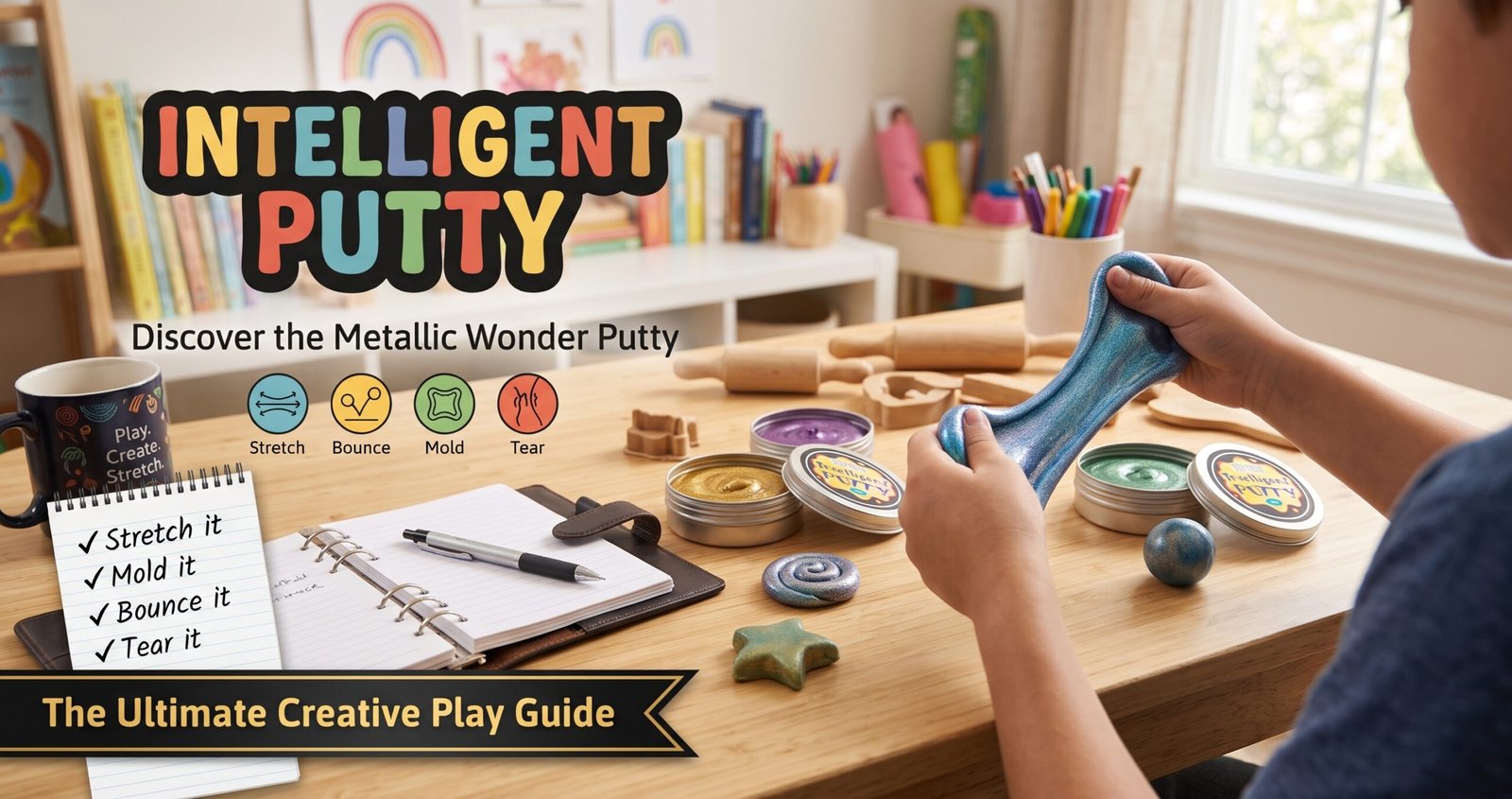
Unlike ordinary modeling clay, Intelligent Putty can demonstrate several physical behaviors using the same piece of material. It may stretch into a long strand when pulled slowly, bounce when shaped into a ball, break under a sudden force, or gradually spread across a surface. Certain specialized versions also respond to magnets, making them useful for interactive experiments.
The word “intelligent” does not mean that the putty contains artificial intelligence, electronic components, or sensors. Instead, it describes its unusual physical response to different conditions. This behavior is associated with a scientific property called viscoelasticity, which combines characteristics of elastic solids and flowing materials.
Intelligent Putty is used for sensory play, creative activities, demonstrations, and learning about material science. Its unusual properties also connect to scientific research into magnetic materials and soft robotics.
Quick Information Table
| Detail | Information |
|---|---|
| Name | Intelligent Putty |
| Product type | Specialty moldable putty |
| Main characteristic | Viscoelastic behavior |
| Physical form | Soft, flexible, moldable material |
| Common behaviors | Stretching, bouncing, tearing, and slow flowing |
| Special varieties | Magnetic, color-changing, and glow-in-the-dark versions |
| Main uses | Sensory play, creative activities, and science demonstrations |
| Typical audience | Children and adults, depending on product age guidance |
| Related product | Silly Putty |
| Scientific concepts | Polymer behavior, elasticity, viscosity, and magnetism |
| Medical status | Not a medical treatment |
| Main safety consideration | Follow product instructions and prevent swallowing |

What Is Intelligent Putty?
Intelligent Putty is a soft material designed to change its physical response according to the force and speed applied to it. It can be squeezed, rolled, stretched, flattened, and reshaped by hand.
Its behavior makes it different from traditional modeling clay. Ordinary clay generally holds the shape given to it until someone reshapes it. Intelligent Putty, however, can behave like an elastic solid under certain conditions and a slowly flowing material under others.
For example, gently pulling the material may allow it to stretch into a long strand. Pulling it suddenly can cause it to tear. Rolling it into a compact ball and dropping it onto a hard surface may produce a bounce. Leaving it on a table for an extended period can cause it to spread gradually under its own weight.
These responses are connected to the internal structure of the material. Its polymer-based composition allows it to respond differently depending on the speed and duration of deformation.
Intelligent Putty is not one standardized chemical formula. Different manufacturers may produce specialty putties with different textures, ingredients, colors, and additional features. Therefore, the exact characteristics depend on the individual product.
How Does Intelligent Putty Work?
The main scientific principle behind Intelligent Putty is viscoelasticity.
Viscoelastic materials display characteristics of both elastic solids and viscous liquids. An elastic material tends to return toward its original shape after being deformed, while a viscous material flows when force is applied.
Intelligent Putty can demonstrate both types of behavior.
Slow Movement and Stretching
When the material is pulled slowly, its internal polymer structure has more time to rearrange. This allows it to extend and deform without immediately breaking.
The result is a long, flexible strand that can be stretched between the hands.
Sudden Force and Breaking
When the same material is pulled very quickly, its internal structure has less time to adjust. It may resist the sudden movement and break rather than stretching smoothly.
This explains why a single piece of putty can behave differently during two simple experiments.
Slow Flow Under Gravity
When left undisturbed, the material may gradually change its shape. Gravity slowly pulls it downward or causes it to spread across a surface.
This process can take much longer than the movement of an ordinary liquid, but it demonstrates that the material is not simply a rigid solid.
The Role of Temperature
Temperature can also influence the texture and behavior of specialty putty. A product may feel softer or firmer under different temperature conditions.
The precise response depends on its formulation. Two putties that look similar may therefore behave differently during the same experiment.
Main Features of Intelligent Putty
Intelligent Putty is popular because it combines several physical characteristics in one material.
1. Stretchable Texture
One of its most noticeable features is its ability to stretch. Users can pull it slowly between their hands, roll it into strands, or flatten it into different shapes.
This makes it suitable for repeated hands-on activities and sensory exploration.
2. Bouncing Behavior
Many formulations can bounce when shaped into a compact ball and dropped onto a hard surface.
During impact, the material can temporarily deform and return some of the energy it receives. The amount of bounce depends on the formulation, temperature, shape, and testing conditions.
3. Ability to Tear
Unlike ordinary rubber, certain putties can break when pulled suddenly or exposed to a sufficiently strong force.
This characteristic makes the material useful for demonstrating how the speed of deformation affects physical behavior.
4. Slow-Flowing Properties
When left alone, putty can gradually spread because of gravity and its ability to deform over time.
This behavior is one of the reasons it is sometimes described as a material that exists between a solid and a liquid.
5. Reusable Material
Many commercial products are designed for repeated handling and do not dry out in the same way as conventional air-drying modeling compounds.
However, this does not mean every formulation lasts forever. Contamination, unsuitable storage, temperature, and normal wear can affect its condition.
6. Different Colors and Textures
Specialty putties are available in various colors and visual styles. Some versions include glitter, metallic effects, unusual textures, or other decorative features.
The exact options depend on the manufacturer and product range.
Magnetic Intelligent Putty
Magnetic putty is a specialized version that responds to magnetic fields. It contains magnetic particles distributed throughout its soft material.
When a suitable magnet is brought close, the putty may move toward it, stretch, form peaks, or change its shape.
This creates an interesting visual demonstration because the material does not simply move as one rigid object. It can deform while responding to magnetic forces.
How Magnetic Putty Works
The magnet interacts with the magnetic particles inside the putty. Because these particles are embedded in a flexible material, the magnetic force can influence the shape and movement of the entire mass.
The result depends on the strength and position of the magnet, the quantity and type of magnetic particles, and the formulation of the putty.
Not every product called Intelligent Putty is magnetic. Buyers should check the product description before expecting this feature.
Magnetic Putty and Scientific Research
Magnetic putty is not limited to novelty toys. Researchers have also investigated specially engineered magnetic putty for soft robotics.
A 2023 research study published in Advanced Materials introduced a magnetic putty designed to be reshaped and remagnetized. The researchers demonstrated properties such as malleability, self-healing, and the ability to be recycled and repurposed.
The research explored potential applications in experimental magnetic robots, flexible structures, and educational prototyping.
This specialized research material should not be confused with every commercially available magnetic toy. Consumer products can have very different compositions and capabilities.
Intelligent Putty vs. Traditional Modeling Clay
Although both materials can be molded by hand, Intelligent Putty and traditional modeling clay serve somewhat different purposes.
| Feature | Intelligent Putty | Traditional Modeling Clay |
|---|---|---|
| Stretching | Often stretches extensively | Usually less elastic |
| Bouncing | Many varieties can bounce | Generally does not bounce in the same way |
| Slow flowing | Can gradually spread | Usually maintains its shape more consistently |
| Sudden pulling | Some varieties may tear | Often deforms or breaks |
| Main purpose | Sensory interaction and experimentation | Sculpting and modeling |
| Magnetic options | Available in specialized varieties | Not a standard feature |
| Storage | Depends on formulation | Depends on clay type |
Modeling clay is generally more suitable when the goal is to create and maintain a particular shape. Intelligent Putty is often more interesting when the activity involves repeated stretching, squeezing, bouncing, and observing physical changes.
Neither material is universally better. The right choice depends on the intended activity.
Common Uses of Intelligent Putty
Intelligent Putty has several practical and recreational uses because it is easy to handle and produces different physical responses.
Sensory Play
Its soft texture and ability to change shape make it suitable for hands-on sensory activities.
Children and adults can squeeze, stretch, roll, and reshape the material while exploring different textures and movements.
Fine-Motor Activities
Repeatedly manipulating putty involves finger movements and hand coordination. It can be included in simple activities that encourage controlled hand movements.
However, its use should not automatically be considered a medical or rehabilitation treatment. Anyone using putty for a therapeutic purpose should follow guidance from an appropriate professional.
Stress-Relief and Fidget Activities
Some adults use putty as a desk or fidget object. Repeated squeezing and stretching can provide a simple physical activity during breaks or periods of concentration.
It can be an enjoyable sensory distraction, but claims that it treats anxiety, ADHD, or other medical conditions require proper clinical evidence.
Creative Projects
Users can roll, flatten, twist, and combine different colors to make temporary shapes and designs.
Because the material can be reshaped, it allows experimentation without requiring a permanent finished model.
Educational Experiments
Intelligent Putty is particularly useful for demonstrating basic scientific ideas.
Students can observe:
- How force affects deformation.
- Why some materials bounce.
- How speed changes the response of a material.
- How gravity affects slowly flowing substances.
- How magnetic forces influence specialized materials.
These experiments provide a practical way to explore material science and physics.
The History Behind Intelligent Putty
The history of specialty putty is closely connected to the development of Silly Putty, one of the best-known novelty materials.
During World War II, researchers were looking for alternatives to natural rubber because wartime conditions threatened rubber supplies. In 1943, General Electric engineer James Wright developed an unusual bouncing material while experimenting with silicone oil and boric acid.
The material was not successful as a replacement for industrial rubber, but it had unusual properties. It could stretch, bounce, and slowly flow when left undisturbed.
The substance eventually attracted the attention of toy marketer Peter Hodgson. In 1950, he introduced it to the public as Silly Putty, selling small portions inside plastic eggs.
The product became popular as a novelty toy and developed a lasting place in toy history. Crayola later acquired the exclusive manufacturing rights in 1977.
Intelligent Putty is a broader description used for specialty putties with unusual physical characteristics. It should not be treated as the name of one specific historical invention or assumed to have exactly the same formula as Silly Putty.
Safety and Proper Handling
Although putty can be enjoyable to handle, product safety should not be overlooked, especially when children are involved.
Avoid Swallowing
Putty is designed for handling, not eating. Children should be supervised and prevented from putting it in their mouths.
Some viscous toys may contain boron compounds, which manufacturers can use to create their elastic and soft properties.
Follow Age Recommendations
Many slime-like and bouncing putty products are not suitable for children under three years old. Always follow the age guidance and warnings printed on the specific product.
Understand Boron Safety
The German Federal Institute for Risk Assessment published an assessment in 2022 concerning boron in toy slime and bouncing putty.
It concluded that acute health effects from accidental ingestion were very unlikely under the exposure conditions it assessed. However, it advised parents to prevent children from swallowing these materials and to follow the manufacturers’ minimum-age recommendations.
This assessment does not mean every product is automatically safe. Formulations and boron levels can vary, so buying products from responsible manufacturers and checking applicable safety information remain important.
Keep the Material Clean
Use putty on clean surfaces and handle it with clean hands. Dust, hair, food particles, and other contaminants can affect its texture.
Store It Properly
Return the material to its original container or another suitable storage container after use. Follow the manufacturer’s instructions about temperature and storage conditions.
Handle Magnets Carefully
Magnetic versions may include strong magnets or magnetic components. Small magnets can be dangerous if swallowed, so keep them away from young children and follow the product’s specific safety instructions.
Latest Developments and Scientific Interest
The most interesting recent development connected to Intelligent Putty is the growing scientific interest in specially engineered magnetic putty.
The 2023 research into reconfigurable magnetic putty demonstrated that a soft material could combine magnetic properties with the ability to change shape and repair itself after being cut or damaged.
This work is relevant to soft robotics, where researchers investigate flexible materials that can move and adapt in ways that rigid machines cannot.
Research published in 2026 has also continued examining the viscoelastic properties of Silly Putty and how additives can influence its behavior, including energy absorption during impact.
These developments show that putty-like materials have potential beyond entertainment. Nevertheless, experimental research materials are not necessarily available as ordinary consumer products.
Frequently Asked Questions
Does Intelligent Putty contain artificial intelligence?
No. The word “intelligent” describes the material’s unusual physical response to different forces and movements. It does not mean that the putty contains AI, electronics, or sensors.
Can Intelligent Putty bounce?
Yes. Many formulations can bounce when shaped into a compact ball and dropped onto a suitable hard surface. The bounce varies according to the product’s composition and conditions.
Is Intelligent Putty magnetic?
Not all varieties are magnetic. Magnetic versions contain magnetic particles that respond to an external magnetic field.
Is Intelligent Putty the same as Silly Putty?
They are related in their unusual physical behavior, but the terms are not interchangeable in every situation. Silly Putty is a specific branded product, while Intelligent Putty is a broader description used for different specialty materials.
Does Intelligent Putty dry out?
Many commercial varieties are designed to remain usable without drying out like ordinary air-drying clay. However, storage conditions and product formulation can affect how long they remain in good condition.
Can adults use Intelligent Putty?
Yes. Adults can use it for sensory activities, creative experiments, and fidgeting. It is not limited to children, although the safety instructions for each product should still be followed.
Is Intelligent Putty safe for children?
Safety depends on the specific formulation, product quality, and age recommendation. Children should not swallow putty, and adults should supervise young users.
Can Intelligent Putty be used in science experiments?
Yes. It can demonstrate viscoelasticity, deformation, elasticity, slow flow, and, in magnetic varieties, the effects of magnetic forces.
Conclusion
Intelligent Putty is an unusual moldable material that combines several physical behaviors in one substance. It can stretch slowly, bounce when shaped into a ball, tear under sudden force, and gradually flow when left undisturbed. These characteristics are primarily connected to viscoelasticity and the way its internal structure responds to different conditions.
Its uses extend beyond ordinary play. It can support sensory exploration, creative activities, basic educational experiments, and demonstrations of material science. Specialized magnetic versions have also attracted scientific interest because of their potential applications in soft robotics and flexible magnetic structures.
The material’s history is connected to the development of bouncing putty and the introduction of Silly Putty in 1950. Today, different specialty products offer varied textures, colors, and magnetic effects.
For anyone interested in trying Intelligent Putty, the most important considerations are its actual formulation, intended use, age recommendation, and safety instructions. When handled responsibly, it offers an engaging way to explore how materials respond to force, movement, and time.