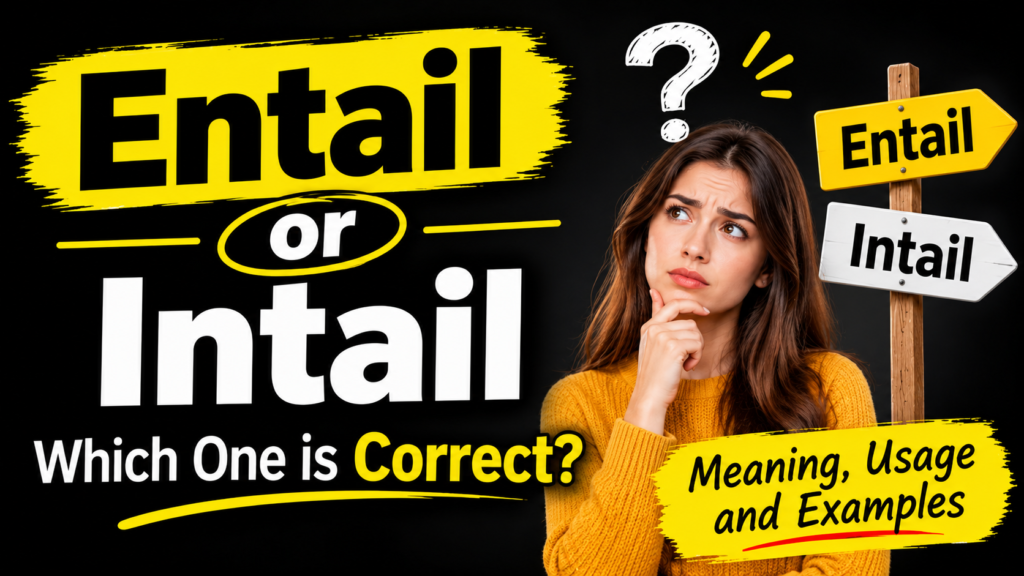
The correct spelling is Entail or Intail. The two words may sound similar when spoken, but only “entail” is the standard English spelling. It is a verb meaning to involve something as a necessary part, result, or consequence. Understanding its definition, pronunciation, origin, and usage can help you avoid this common spelling mistake.
Entail or Intail: Which Spelling Is Correct?
The correct modern English spelling is entail. It is the standard form used in dictionaries, professional writing, education, and everyday communication.
However, intail is not entirely unrelated to the word. It is recorded as an obsolete historical spelling of entail. This means it appeared in older English but is not the appropriate spelling for modern writing.
If you are writing an email, article, academic assignment, business document, or social media post, use entail.
What Does Entail Mean?
Entail or Intail is a verb that means to involve something as a necessary part, require a particular action, or bring about a consequence. It is generally used when one activity, decision, or situation naturally includes certain responsibilities, conditions, risks, or results.
In simple words, if something entails something else, it means that the second thing is required, involved, or comes as a consequence of the first.
For example:
- Starting a business entails financial risks.
- The new position entails working long hours.
- Building a house entails careful planning and preparation.
- Moving to another country may entail learning a new language.
In each example, the word explains what is involved or required by a particular activity.
Entail is generally considered a formal verb, so it is especially common in professional communication, academic writing, business discussions, and explanatory articles. English meaning – Cambridge Dictionary+2
Why Is Entail Correct Instead of Intail?
The confusion between entail and intail often comes from their similar pronunciation. Both spellings may appear to sound alike to some English speakers, but they do not have the same status in modern English.
Entail is the accepted contemporary spelling. It is used to describe something that involves, requires, or produces a particular consequence.
Intail is an obsolete spelling historically associated with entail. It can appear in older texts and historical references, but it is not the standard spelling used in modern English.
| Spelling | Status | Explanation |
|---|---|---|
| Entail | Correct | Standard modern English spelling |
| Intail | Obsolete | Historical spelling, not standard in modern writing |
The important point is that intail has a historical connection to the word, but that does not make it an acceptable alternative for ordinary modern writing. Oxford Learner’s Dictionaries+2
What Is the Meaning of Intail?
Intail is an obsolete spelling of entail. It is associated with an older form of English spelling and is sometimes mentioned in historical dictionaries and word-origin references.
In older English, spelling conventions were not always as standardized as they are today. Words could appear in different written forms across historical periods, manuscripts, and publications.
The spelling intail is therefore relevant when studying the history of English vocabulary. However, it should not be treated as a modern spelling choice.
For example:
- Modern: The project will entail additional expenses.
- Not recommended: The project will intail additional expenses.
The first sentence follows current English spelling conventions. The second uses an obsolete form and should be avoided in contemporary writing.
History and Origin of the Word Entail
The word entail has an interesting history connected to property ownership, inheritance, and legal restrictions.
It entered Middle English during the medieval period, with its earlier forms influenced by Old French. Its historical development is associated with the idea of limiting or fixing how property could be inherited.
The word is connected to Old French taillier, meaning to cut or shape, and related forms associated with legal limitations on inheritance.
Original Legal Meaning
Historically, entail was used in property law to describe arrangements that restricted how an estate could be passed down through generations.
Under such an arrangement, property could be reserved for particular heirs or a specific line of descendants. The owner could not necessarily sell, transfer, or distribute the property freely.
For example, a landowner might establish an arrangement that allowed an estate to pass to a particular family line rather than being divided among unrelated individuals.
This historical legal meaning helped establish the idea of something being fixed or restricted.
Development of the Modern Meaning
Over time, the word developed a broader meaning.
Instead of referring only to restricted inheritance, entail began to describe situations in which one action necessarily involved another action, responsibility, or consequence.
The modern sense of having consequences is recorded from around 1829 in historical etymological references.
Today, this broader meaning is the one most commonly encountered in ordinary English. Oxford Learner’s Dictionaries+2
Different Meanings and Uses of Entail
Although entail is most commonly used to mean involve or require, it also has a historical and technical legal meaning.
1. Entail as Something That Is Required
The most common meaning of entail is to make something necessary or involve it as an essential part of an activity.
Example:
“Completing this assignment will entail several hours of research.”
This means that research is necessary to complete the assignment.
2. Entail as a Consequence
Entail can also describe something that naturally follows from a decision, action, or situation.
Example:
“Expanding the company may entail additional financial risks.”
This means that expansion may bring additional risks.
3. Entail in Property Law
In historical property law, entail refers to restricting the inheritance of an estate to a specified family line or group of heirs.
Example:
“The family estate was entailed to the eldest male descendants.”
This describes a historical inheritance arrangement in which property was restricted to a particular line of succession.
The legal meaning is less common in everyday conversation, but it remains important when reading historical documents and discussing inheritance law. English meaning – Cambridge Dictionary+2
How to Use Entail in a Sentence
Understanding the correct spelling is only one part of using the word properly. It is also important to understand how entail fits into a sentence.
Here are several examples from different situations.
Everyday Examples
- Buying a new car may entail additional monthly expenses.
- Moving into a larger house will entail higher maintenance costs.
- Learning a new skill often entails patience and regular practice.
- Organizing a large event can entail considerable preparation.
- Taking responsibility for a project entails completing assigned tasks.
Business Examples
- The new marketing strategy will entail additional investment.
- Expanding into international markets may entail legal requirements.
- The management position entails supervising a team.
- The agreement may entail certain financial responsibilities.
- Implementing the new system will entail employee training.
Academic Examples
- Conducting scientific research entails collecting reliable information.
- Completing the experiment will entail following specific procedures.
- The theory entails several important assumptions.
- Studying historical events often entails examining different perspectives.
These examples show how entail can communicate requirements, responsibilities, and consequences in a concise way.
Common Sentence Structures With Entail
There are several useful grammatical patterns for using entail correctly.
Entail + Noun
This is one of the most common sentence structures.
Examples:
- The decision entails financial risk.
- The position entails responsibility.
- The project entails additional costs.
In these sentences, the noun identifies what is involved or required.
Entail + Verb Ending in -ing
Entail can also be followed by a gerund, which is a verb ending in -ing that functions as a noun.
Examples:
- The job will entail traveling frequently.
- The repair will entail replacing several parts.
- Starting the project entails hiring additional employees.
This structure is particularly common when explaining activities or responsibilities.
Entail + Someone + Verb Ending in -ing
The word can also be used with an object followed by a gerund.
Example:
“The new schedule will entail employees working additional hours.”
Here, the sentence explains what the new schedule requires employees to do.
Be Entailed in Something
This structure can be used when asking what is involved in a particular activity.
Example:
“Applicants should understand what is entailed in the position.”
It means applicants should understand the responsibilities and requirements associated with the job. Oxford Learner’s Dictionaries+1
What Are the Different Forms of Entail?
Entail is a regular English verb, which means its past and participle forms follow a common spelling pattern.
| Verb Form | Spelling | Example |
|---|---|---|
| Base form | Entail | The job may entail travel. |
| Third-person singular | Entails | The position entails responsibility. |
| Past tense | Entailed | The project entailed extra expenses. |
| Past participle | Entailed | The work has entailed several challenges. |
| Present participle | Entailing | The changes are entailing additional costs. |
The noun form is entailment, which refers to the act, process, or result of entailing something. It is also used in specialized fields such as logic and linguistics.
Synonyms of Entail
Several English words have meanings similar to entail. However, their use depends on the sentence and intended meaning.
| Synonym | Meaning |
|---|---|
| Involve | Include something as part of an activity |
| Require | Make something necessary |
| Necessitate | Make something essential or unavoidable |
| Imply | Suggest or indicate something |
| Demand | Need or call for something |
| Include | Contain something as a part |
| Incur | Become subject to a cost, debt, or consequence |
| Carry | Have something as an associated result |
Entail vs. Involve
Entail and involve are closely related. Both can describe something that includes another activity or responsibility.
For example:
- The job involves traveling.
- The job entails traveling.
Both sentences communicate that traveling is part of the job. Entail can sound slightly more formal and may emphasize that something is a necessary part of the activity.
Entail vs. Require
Require focuses more directly on something being necessary.
For example:
- The position requires professional experience.
- The position entails working with customers.
The first sentence emphasizes a qualification that someone must have. The second describes an activity that forms part of the position.
Entail vs. Imply
Imply means to suggest or indicate something without stating it directly.
Entail generally communicates a stronger connection involving a necessary element or consequence.
For example:
- His statement implies that he disagrees.
- Completing the project entails careful planning.
The two words have different functions and should not automatically replace one another.
Common Spelling Mistakes Related to Entail
English spelling can be confusing because similar sounds do not always have identical written forms. Entail and intail are an example of this problem.
Here are some useful ways to avoid mistakes.
Remember the Correct First Letter
The standard spelling begins with E, not I.
Write:
- Entail
- Entails
- Entailed
- Entailing
- Entailment
Avoid using intail, intails, or intailed in modern writing.
Learn the Word in Complete Sentences
Remembering a word through examples can make its spelling easier.
For example:
“The project will entail additional expenses.”
Repeated exposure to the correct form can help prevent spelling mistakes.
Use a Dictionary When Unsure
If you are uncertain about a word’s spelling or meaning, consult a reliable English dictionary. This is especially useful when writing professional documents, articles, academic assignments, or business communication.
Frequently Asked Questions About Entail or Intail
Is it entail or intail?
Entail is the correct standard spelling in modern English. Intail is an obsolete historical spelling and should not be used in ordinary contemporary writing.
What does entail mean in simple words?
Entail means to involve, require, or bring something as a necessary part or consequence of an activity or situation.
Is intail a real English word?
Intail is recorded as an obsolete spelling of entail. Although it has historical usage, it is not the standard modern spelling.
What is the past tense of entail?
The past tense of entail is entailed.
Example: “The project entailed additional research.”
What is the noun form of entail?
The noun form is entailment. It can refer to the process or result of entailing something and has specialized uses in logic and linguistics.
Is entail formal or informal?
Entail is generally considered a formal verb. It is frequently used in professional, academic, legal, and business writing, although it can also appear in everyday conversations.
What is another word for entail?
Common alternatives include involve, require, necessitate, and imply. The best choice depends on the meaning of the sentence.
How do you pronounce entail?
Entail is pronounced in-TAYL, with emphasis on the second syllable. Its phonetic pronunciation is /ɪnˈteɪl/. English meaning – Cambridge Dictionary+1
Final Thoughts on Entail or Intail
When choosing between entail and intail, the correct modern spelling is entail. It is a standard English verb meaning to involve something, make something necessary, or bring about a particular consequence.
Although intail appeared as an older spelling, it is now considered obsolete. The word entail has a long history connected to property inheritance and legal restrictions, but its modern use mainly focuses on requirements, responsibilities, and consequences.
Remembering the correct spelling and understanding how to use it in sentences will help improve your English writing. Whether you are discussing business responsibilities, academic work, personal decisions, or everyday activities, entail is the appropriate word for modern communication.