
A pirate ship amusement park ride is a classic attraction that combines the appearance of a sailing ship with the thrilling motion of a giant swing. Designed for families and thrill-seekers, the ride moves a boat-shaped passenger gondola backward and forward in a pendulum-like arc. As the ship rises higher on each swing, riders experience a feeling of weightlessness, excitement, and anticipation before it changes direction and swings back.
Found at amusement parks, theme parks, traveling fairs, and family entertainment venues, pirate ship rides remain popular because they offer an exciting experience without requiring the complex movements of a roller coaster. Some versions feature traditional pirate decorations, while others are styled as Viking ships, fantasy vessels, or other nautical attractions.
Quick Information Table
| Feature | Details |
|---|---|
| Ride name | Pirate ship amusement park ride |
| Common ride type | Pendulum or swinging gondola ride |
| Main design | Boat-shaped passenger gondola suspended on a support structure |
| Primary movement | Backward and forward swinging |
| Common theme | Pirates, sailing ships, and maritime adventures |
| Typical experience | Rising and falling motion with changing acceleration |
| Main components | Gondola, support frame, pivot or drive system, seats, and restraints |
| Intended audience | Families and thrill-seekers, depending on the model |
| Ride duration | Varies by manufacturer and operator |
| Passenger capacity | Depends on the specific model |
| Common locations | Amusement parks, theme parks, and traveling fairs |
| Safety requirements | Height limits, restraints, inspections, and operator instructions |
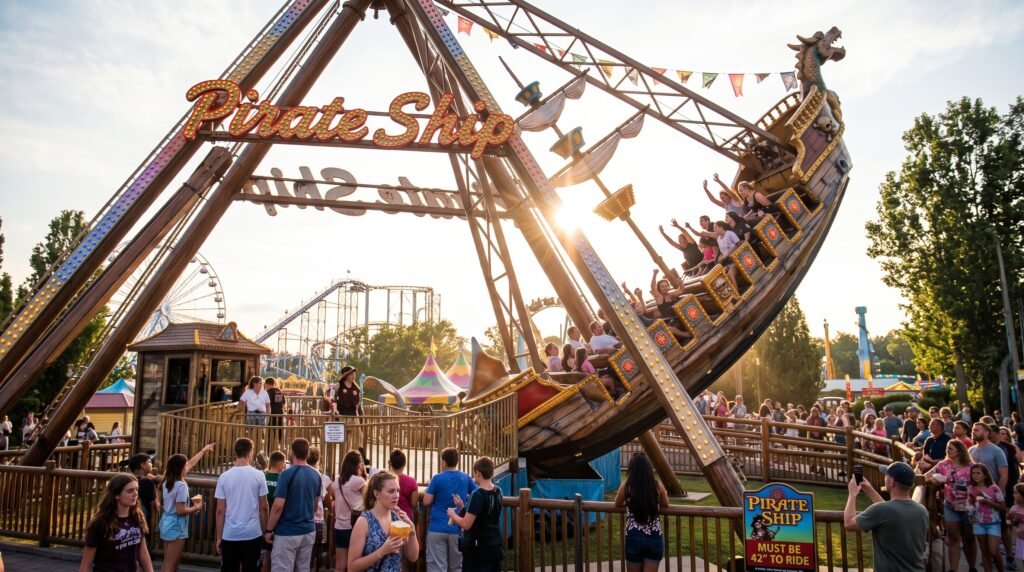
What Is a Pirate Ship Amusement Park Ride?
A pirate ship ride is a mechanical amusement attraction built around a large boat-shaped gondola that swings through the air. The gondola is attached to a strong support structure and moves around a pivot, creating a motion similar to a playground swing but on a much larger scale.
The boat usually has several rows of seats arranged across its width. Passengers sit facing the same direction or according to the manufacturer’s seating design, with safety restraints securing them during the ride. As the ride begins, the gondola swings gently before increasing its movement and reaching greater heights.
The pirate theme is an important part of its appeal. The boat may feature decorative sails, wooden-ship styling, skull-and-crossbones artwork, pirate flags, or other maritime details. However, the appearance and level of theming vary from one installation to another.
Although the attraction is often called a pirate ship ride, similar rides can use different names. Some are presented as Viking ships or other themed vessels while using a comparable swinging mechanism.
How Does a Pirate Ship Ride Work?
The basic principle behind a pirate ship ride is the controlled movement of a large gondola through a pendulum-like arc. Its mechanical system repeatedly drives the ship in opposite directions, allowing it to climb higher before returning toward the center.
The Swinging Mechanism
The passenger boat is connected to a support structure through an axle, pivot, or comparable mechanical arrangement. Depending on the model, an electric drive system helps move the gondola and control its swinging cycle.
At the beginning, the boat may move through a relatively small arc. The drive system then increases the swing, sending the gondola farther to one side and then the other. The process continues until the programmed ride cycle reaches its intended movement.
Unlike a free-swinging playground swing, a powered amusement ride uses engineered machinery and control systems to deliver a repeatable experience.
Why the Boat Reaches Greater Heights
The ride’s movement is based on the relationship between motion, energy, gravity, and mechanical power. As the boat moves upward, some of its kinetic energy is converted into gravitational potential energy. Near the highest point of each swing, the gondola slows down before reversing direction.
A powered ride can add energy to the movement on successive swings, allowing the boat to climb higher than it would through an ordinary, unpowered swing.
At the highest points, riders may feel as though their bodies are becoming lighter. This sensation comes from changes in acceleration and the forces acting on the passengers. The exact feeling depends on the ride’s design, speed, swing angle, and direction of movement.
The Ride’s Operating Cycle
A typical operating cycle includes several stages:
- Boarding: Guests take their assigned seats while operators check the restraints.
- Initial movement: The boat starts swinging through a relatively small arc.
- Increasing motion: The mechanism drives the gondola through progressively larger swings.
- Peak movement: The ship reaches its intended maximum swing angle for that ride cycle.
- Deceleration: The system reduces the motion until the gondola returns to a controlled position.
- Unloading: Guests leave the boat after the operator confirms that it is safe to exit.
The precise sequence, duration, and motion profile depend on the manufacturer’s equipment and the operating program selected by the park.
History of the Pirate Ship Amusement Park Ride
The pirate ship ride belongs to a broader family of swinging-ship attractions that developed from the simple idea of turning a familiar swinging motion into an amusement experience. Over time, manufacturers transformed this basic movement into large mechanical attractions capable of carrying dozens of passengers.
Early Swinging-Ship Attractions
Swinging boats and ship-shaped rides appeared in amusement settings before the modern, powered versions became widely recognized. Early designs relied on relatively simple mechanical arrangements, while later models incorporated stronger support structures, powered movement, and improved passenger restraints.
The exact origin of the first pirate ship ride is difficult to establish because similar attractions were developed under different names and by different manufacturers. The modern ride category should therefore be understood as an evolution of swinging-ship attractions rather than the invention of a single individual or company.
Development of Modern Commercial Models
During the late 1970s, manufacturers introduced modern commercial versions of the ride. HUSS, a German amusement ride manufacturer, introduced its Pirat model in 1978. Other companies developed their own versions around the same period, helping the swinging-ship concept become a familiar attraction at permanent parks and traveling fairs.
By the 1980s and 1990s, pirate ship rides could be found in many amusement parks around the world. Their relatively straightforward swinging motion, recognizable appearance, and ability to accommodate groups of passengers helped them become established attractions.
Some rides have remained in service for decades, while others have been relocated, refurbished, or removed as parks update their attractions. A ride’s continued operation depends on its condition, maintenance requirements, replacement parts, and the park’s plans.
Main Features of a Pirate Ship Ride
Although individual models differ, most pirate ship rides share several important characteristics.
Boat-Shaped Passenger Gondola
The gondola is the most recognizable part of the attraction. It is designed to resemble a ship and provides seating for passengers across multiple rows. Its size, shape, decorative details, and seating arrangement depend on the manufacturer.
Larger models may carry around 50 passengers or more, while smaller versions are designed for fewer riders. Some attractions use child-friendly designs with lower capacity and gentler motion.
Strong Support Structure
A substantial steel frame supports the gondola and its moving mechanism. The structure must withstand the forces produced by the boat’s weight, movement, and passenger load throughout repeated operating cycles.
The frame’s dimensions and design vary according to the model. Some installations are permanent park attractions, while others are designed to be transported and assembled at traveling fairs.
Powered Drive System
Many modern pirate ship rides use an electric drive system to control the swinging motion. The system applies power in a carefully managed way so that the gondola can reach its intended swing angle and return to its loading position.
The drive mechanism, braking arrangements, and control equipment differ across designs. These systems must be maintained according to the manufacturer’s requirements.
Seats and Passenger Restraints
Seats are arranged to accommodate passengers securely during the ride. Depending on the model, restraints may include lap bars, individual locking systems, or other approved arrangements.
Operators check that passengers are correctly seated and that restraints are properly secured before starting the ride. The exact requirements depend on the equipment and the park’s operating procedures.
Lighting and Theming
Pirate ship rides are often visually striking attractions. Decorative sails, themed paintwork, flags, lighting, and nautical scenery help create a maritime atmosphere.
Some parks add music, sound effects, or surrounding scenery to make the attraction feel like a ship caught in a storm. These features are optional and should not be assumed to exist on every model.
Types and Variations of Pirate Ship Rides
The term pirate ship amusement park ride describes a general ride category rather than one standardized machine. Several variations are available.
Traditional Pendulum Ship
This is the familiar version in which a large boat-shaped gondola swings backward and forward from a high support structure. The boat generally does not complete a full rotation.
Traditional models can range from relatively small family rides to large attractions that provide a more intense swinging experience.
Family-Friendly Pirate Ship
Family versions are designed to provide an enjoyable experience for a broader audience, subject to the manufacturer’s restrictions and the park’s rules. They may have smaller gondolas, lower operating heights, or a less intense motion profile than larger thrill rides.
A family label does not mean that everyone can ride. Minimum height requirements and other restrictions may still apply.
Viking Ship Rides
Some attractions use Viking ships rather than pirate vessels as their central theme. Although the decoration and storytelling differ, the underlying swinging motion can be very similar.
For example, Drageskibet at Djurs Sommerland in Denmark is a HUSS swinging-ship attraction themed as a Viking vessel. The ride demonstrates how the same mechanical concept can support different visual themes.
Portable Fairground Versions
Some pirate ship rides are designed for traveling amusement operators. These models can be transported between events and assembled at different venues.
Portable rides need to balance passenger capacity, structural strength, transportation requirements, assembly time, and operational reliability. Their dimensions and setup requirements vary by manufacturer.
Examples of Pirate Ship Ride Specifications
Technical specifications are not identical across the category. The following examples illustrate how models differ.
| Manufacturer or model | Example specifications |
|---|---|
| HUSS Pirate Ship | Park model footprint of approximately 13 m × 10 m |
| HUSS Pirate Ship | Full-swing height of approximately 19.5 m |
| HUSS Pirate Ship | Model versions listed with capacity for 50 or 60 passengers |
| SBF-VISA Pirate Ship | A large model listed for 32 adults or up to 40 passengers when children are included |
| SBF-VISA Pirate Ship | Listed height of approximately 13.96 m |
These figures come from manufacturer specifications and apply to the models described, not to every pirate ship ride. Actual passenger capacity, height, footprint, and operating characteristics should always be checked for the specific installation.
Why Are Pirate Ship Rides So Popular?
Pirate ship rides have remained familiar attractions for several reasons.
A Thrilling but Understandable Experience
The movement is easy to understand: the boat swings higher, slows near the top, and moves back in the opposite direction. Riders can anticipate the next swing while still experiencing the excitement of the changing motion.
Unlike some high-intensity attractions, traditional pirate ships do not usually rely on inversions or rapid sequences of complicated movements. However, larger models can still feel intense, especially near the ends of the boat.
Shared Group Experience
The ride accommodates multiple passengers at once, making it suitable for friends and families who want to experience the attraction together. Reactions to the changing height and motion often become part of the fun.
Strong Visual Appeal
The large ship-shaped gondola is easy to recognize from a distance. Decorative sails, lighting, and themed structures can make the ride a visual centerpiece of an amusement park’s midway or family area.
Different Levels of Intensity
Because manufacturers offer different sizes and designs, parks can choose a model suited to their audience and available space. A small swinging ship may appeal to families, while a larger version can serve visitors looking for a more powerful thrill.
Safety Rules and Height Restrictions
Safety is an essential part of operating a pirate ship amusement park ride. Although the basic motion is straightforward, the attraction involves a heavy moving structure, mechanical equipment, and passengers exposed to changing forces.
Height and Passenger Requirements
Minimum height requirements vary by ride and park. For example, a park may set a different minimum height from another park operating a similar manufacturer’s model. Age, supervision, seating, and other restrictions may also differ.
Guests should read the safety information displayed at the attraction and follow the operator’s instructions. They should not assume that meeting the height requirement at one park automatically qualifies them to ride every pirate ship.
Proper Use of Restraints
Passengers must remain seated and use the restraint system as instructed. They should not attempt to stand, change seats, lean outside the gondola, or release a restraint during the operating cycle.
Loose items such as phones, hats, and unsecured bags can fall from the ride. These items should be stored as directed by the park.
Inspections and Maintenance
Ride operators and maintenance teams must follow the applicable regulations, technical requirements, and manufacturer’s instructions. Safety programs can include operational checks, component inspections, preventive maintenance, and more detailed examinations of structural and mechanical systems.
Industry guidance emphasizes that amusement ride safety depends on design, manufacture, inspection, operation, and ongoing maintenance. Applicable rules vary by location, so the precise requirements are not identical worldwide.
Who Should Consider Skipping the Ride?
Visitors should review posted warnings concerning medical conditions, pregnancy, motion sensitivity, and other restrictions. Anyone who is unsure whether a ride is appropriate for them should consult the park’s safety information or staff before boarding.
Pirate Ship Ride Compared With Other Attractions
A pirate ship ride differs from several other common amusement park attractions.
| Ride type | Main movement | Main experience |
|---|---|---|
| Pirate ship | Back-and-forth swinging | Rising and falling in a pendulum arc |
| Roller coaster | Travel along a track | Drops, turns, speed, and sometimes inversions |
| Ferris wheel | Slow circular rotation | Elevated views and a comparatively gentle ride |
| Swing ride | Seats move around a central structure | Circular motion with outward movement |
| Looping pendulum ride | Swinging combined with full rotations on some designs | More intense movement that may include inversions |
A traditional pirate ship usually swings without turning completely upside down. Specialized rides that combine swinging with full rotations belong to a different, more intense variation of the broader pendulum-ride family.
Latest Trends in Pirate Ship Amusement Park Rides
The basic swinging-ship concept has remained recognizable, but manufacturers can update the attraction through design and presentation.
Custom Themes and Lighting
Modern ride offerings may include customized decorations, lighting packages, sound, and special effects. These options allow parks to match the attraction to a particular story or themed area.
Updated Ride Controls
Modern amusement ride engineering uses control systems and other technologies to manage operation. The exact equipment varies between models, and it is important not to assume that every older ride has the same features as a newly manufactured attraction.
Refurbishment and Replacement
Some parks refurbish existing rides to extend their service life, while others replace older equipment with new attractions. Maintenance costs, the availability of spare parts, visitor demand, and redevelopment plans can all influence these decisions.
There is no single worldwide update or universal release date for the pirate ship ride category as a whole. New installations, refurbishments, and closures occur at individual parks and should be checked separately when current operating status matters.
Frequently Asked Questions
Does a pirate ship amusement park ride go upside down?
Most traditional pirate ship rides swing backward and forward without completing a full rotation. Specialized attractions may combine a similar swinging motion with inversions, but those are different designs.
How high does a pirate ship ride go?
The maximum height depends on the model and its swing angle. One HUSS park model lists a full-swing height of approximately 19.5 metres, but other rides may be smaller or larger.
How many people can ride at once?
Passenger capacity varies. Some models accommodate a few dozen people, while certain larger versions list capacity for approximately 50 or 60 passengers.
Is a pirate ship ride suitable for children?
Some models are designed for families, but children must meet the specific height and safety requirements. Parents and guardians should check the posted rules before boarding.
How long does a pirate ship ride last?
Ride duration depends on the operator’s program and the model. The boarding, restraint-checking, operating, and unloading processes also affect the total time visitors spend at the attraction.
Are pirate ship rides still found in amusement parks?
Yes. Pirate ship and similarly themed swinging-ship attractions continue to operate at parks and fairs in different countries. However, the status of a specific ride can change, so visitors should check the relevant park’s current attraction information.
Conclusion
The pirate ship amusement park ride is a classic attraction that combines a recognizable sailing-ship design with the physics of a powered pendulum. Its swinging motion, group seating, customizable themes, and range of sizes have helped it remain part of amusement park culture for decades.
From traditional pirate vessels to Viking-themed ships and portable fairground models, the category offers different experiences built around the same basic idea. Ride specifications, passenger capacity, intensity, and restrictions vary by manufacturer and installation. Understanding these differences helps visitors know what to expect and enjoy the attraction responsibly.



3 thoughts on “Limited Pirate Ship Amusement Park Ride: How It Works, History, and Features 2026”
Comments are closed.