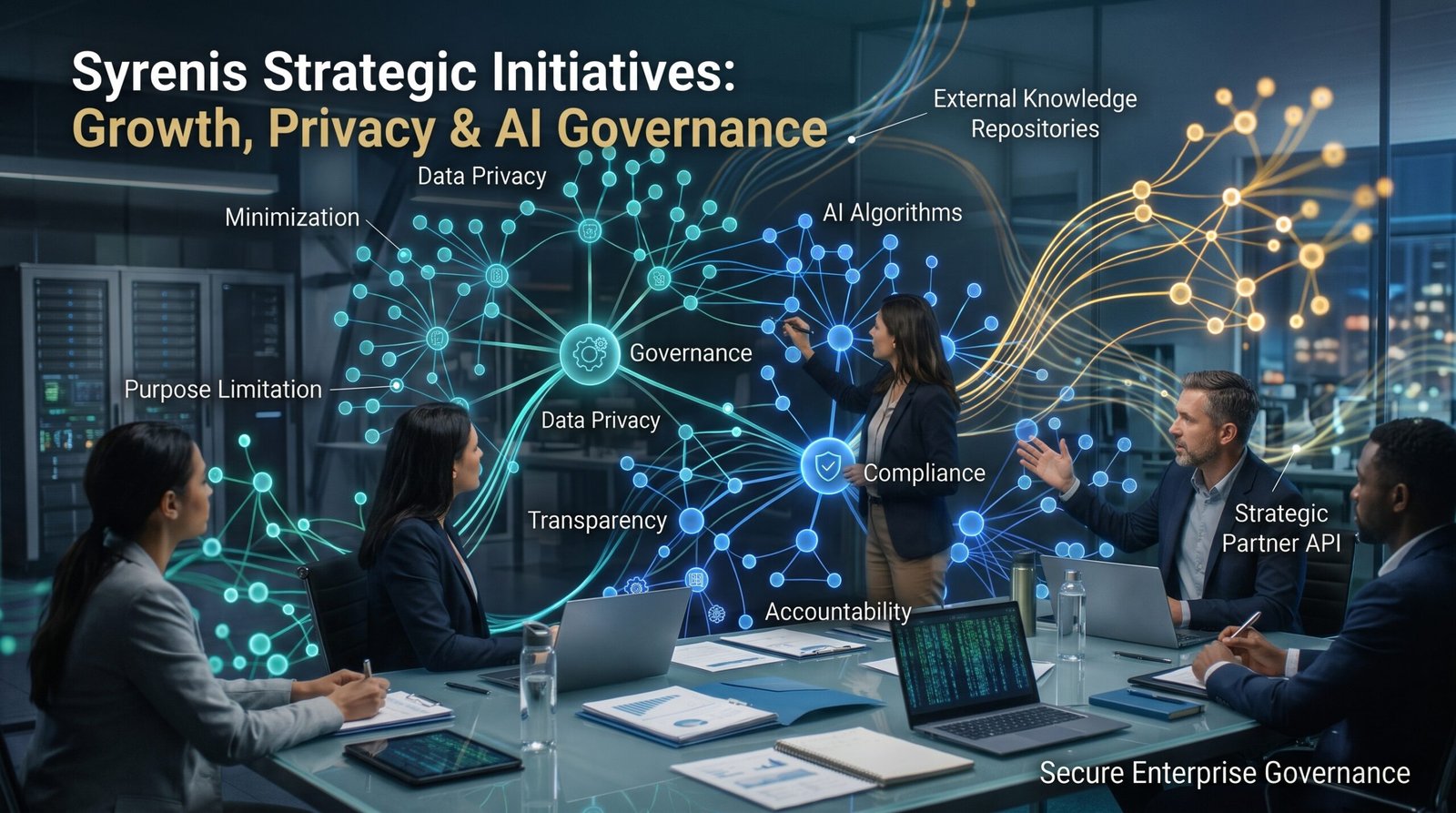
Syrenis strategic initiatives focus on expanding the company’s presence in the enterprise privacy technology market, strengthening its consent and preference management platform, and helping organizations manage customer data responsibly. As privacy regulations evolve and businesses operate across more digital channels, companies need reliable ways to record customer choices, coordinate permissions, and demonstrate compliance.
Syrenis addresses these challenges through enterprise software designed to manage consent, customer preferences, privacy requirements, and data connections across complex business environments. Its broader direction includes international expansion, product development, commercial growth, and a stronger market position in privacy technology.
Recent developments have reinforced this direction. The company expanded its presence in the United States, strengthened its leadership team, and introduced a unified brand identity in 2026. These developments indicate a strategy that aims to position privacy management as more than a regulatory requirement: it can also support customer trust, responsible data use, and sustainable business growth.
Quick Information Table
| Detail | Information |
|---|---|
| Company | Syrenis |
| Industry | Privacy technology and enterprise software |
| Main specialization | Consent and preference management |
| Core platform | Syrenis enterprise privacy platform |
| Earlier product identity | Cassie |
| Main strategic goal | Global growth and enterprise expansion |
| Key markets | United Kingdom, United States, and other international markets |
| Main priorities | Privacy compliance, technology development, customer trust, and commercial growth |
| Leadership development | Adam Binks became CEO in February 2025 |
| Recent brand development | Unified brand relaunch in April 2026 |
| Target customers | Large organizations with complex data and privacy requirements |

What Are Syrenis Strategic Initiatives?
Syrenis strategic initiatives are the business priorities and development activities intended to strengthen its position in the enterprise privacy technology market.
The company specializes in helping organizations manage customer consent and preferences across websites, applications, customer databases, marketing systems, and other digital environments. Large businesses often operate multiple brands and serve customers in different countries. As a result, keeping privacy choices consistent across all these systems can become difficult.
Syrenis aims to address this challenge through centralized consent management, integration capabilities, privacy governance, and tools that help businesses honor customer choices across different touchpoints.
Its strategic direction can be understood through several major areas:
- Expanding its international commercial presence.
- Developing and modernizing its enterprise privacy platform.
- Helping businesses manage complex privacy requirements.
- Improving customer experiences through preference management.
- Building stronger commercial partnerships.
- Aligning its brand and market positioning with enterprise customers.
These priorities are connected. Product development supports customer needs, international expansion increases market reach, and stronger privacy capabilities help organizations manage risk while using customer data responsibly.
1. Expanding Into International Markets
International expansion is one of the most visible elements of Syrenis’s recent strategy.
Growth in the United States
In January 2026, Syrenis established a dedicated United States presence to support its commercial activities across North America. The expansion included a team focused on sales, partnerships, and customer engagement. The move reflects the importance of the US market to the company’s growth plans.
The American privacy environment presents a substantial challenge for large businesses. Rather than relying on one comprehensive federal privacy framework equivalent to the European Union’s GDPR, companies may need to account for different state-level requirements alongside other applicable laws.
For organizations operating nationwide, these differences can affect how customer information is collected, how consent is recorded, and how privacy choices are applied across digital services.
Syrenis’s US expansion gives it a more direct commercial presence in a market where enterprises face these operational challenges. Local engagement can also help the company build relationships with prospective customers and partners.
Supporting global enterprise customers
International expansion also means supporting organizations that operate across multiple regions. These businesses may need consistent privacy processes while respecting differences in local laws, languages, brands, and data-handling requirements.
A scalable privacy platform can help centralize governance without requiring every market to operate independently.
The long-term opportunity is to make consent management easier to administer across large organizations while allowing appropriate regional flexibility.
2. Developing Enterprise Privacy Technology
Another major initiative is the continued development of the Syrenis platform.
The company has evolved beyond a narrow focus on website cookie notices toward a broader enterprise approach to consent, preferences, identity, privacy rights, and data integration. Its platform is designed to help organizations maintain a consistent record of customer choices across complex technology environments.
Centralized consent management
Consent management involves collecting, recording, and applying a person’s permission choices concerning particular uses of personal data.
For example, a customer might agree to receive marketing emails but decline certain tracking technologies. A business needs a reliable way to record these choices and ensure that relevant systems respect them.
Syrenis’s approach aims to establish a central source of truth so that consent information can be shared with connected systems and applied consistently.
This is particularly important for organizations that manage many websites, customer databases, brands, and marketing platforms.
Preference management
Consent and preferences are related but distinct concepts. Consent concerns permission where a legal or operational basis requires it, while preferences can also describe choices about communications, content, channels, and customer experiences.
A preference management system can allow customers to choose which communications they receive and how they interact with an organization.
For businesses, this can help reduce irrelevant messaging, improve transparency, and support more useful customer relationships.
Identity and cross-domain consent
Customers may interact with a company through several devices, websites, applications, or business units. If each system stores separate information, it can become difficult to maintain consistent choices.
Syrenis offers capabilities designed to connect consent with identities and coordinate preferences across different digital environments. These functions are particularly relevant to large enterprises with multiple brands or interconnected customer systems.
3. Strengthening Privacy Compliance and Governance
Privacy compliance is a central part of Syrenis’s business strategy.
Organizations operating internationally may need to consider frameworks such as the General Data Protection Regulation (GDPR), the California Consumer Privacy Act (CCPA), and other applicable national or regional privacy laws.
The precise legal obligations depend on factors such as the location of the individual, the type of data involved, the organization’s activities, and the legal basis for processing.
Maintaining auditable records
Businesses need to demonstrate how consent was collected, when a preference changed, and whether a withdrawal was applied correctly.
A structured consent management platform can maintain records of these events and make relevant information available for compliance reviews.
This can improve accountability and reduce the difficulty of gathering evidence from separate systems.
Applying privacy choices across systems
Recording a choice is not enough if connected systems continue to act on outdated information.
A privacy platform can help synchronize updated permissions with relevant marketing, customer relationship management, and data platforms. This makes it easier for organizations to align operational activity with the latest recorded choices.
Managing changing regulations
Privacy laws and regulatory guidance evolve over time. Companies operating in several jurisdictions need processes that can accommodate different requirements without creating unnecessary operational complexity.
Syrenis’s strategic focus on centralized governance and configurable consent management is intended to help enterprise customers address these challenges.
However, using privacy software does not automatically guarantee legal compliance. Organizations still need appropriate policies, accurate configurations, legal guidance, and effective internal processes.
4. Repositioning the Brand for Enterprise Growth
Brand development is another important part of Syrenis’s strategy.
On April 21, 2026, the company announced a brand relaunch that consolidated its previous product branding under the unified Syrenis name. The repositioning was intended to reflect the company’s evolution toward a broader enterprise privacy technology platform.
Moving beyond a compliance-only message
Privacy technology has traditionally been discussed mainly in terms of legal obligations, risk reduction, and regulatory compliance.
Syrenis’s newer positioning emphasizes that privacy management can also support better customer relationships and sustainable growth. When customers understand their choices and businesses respect those choices consistently, organizations can build a stronger foundation for responsible personalization.
This approach presents privacy as part of the customer experience rather than as a separate administrative task.
Building a clearer enterprise identity
Large organizations often have complicated systems, international operations, and extensive data flows. A brand focused on enterprise-scale privacy management can communicate that the company’s intended audience includes businesses with demanding governance and integration requirements.
The 2026 relaunch also supports the company’s international expansion by presenting a unified identity to enterprise customers across the United States, United Kingdom, and Europe.
The brand change does not, by itself, prove a particular increase in sales or customer adoption. Its significance lies in the strategic positioning it communicates.
5. Strengthening Leadership and Commercial Execution
Leadership development has played a role in Syrenis’s recent growth strategy.
Adam Binks joined the company’s board in October 2024 and became chief executive officer in February 2025. In March 2025, Syrenis announced further senior leadership appointments, including Martin Audcent as chief financial officer and Paul Glynn as chief sales officer. The announcements coincided with the company’s 25th anniversary.
Supporting financial discipline
International expansion and product development require careful investment. Financial leadership helps an organization plan spending, manage resources, assess risks, and support sustainable growth.
For a software company targeting large enterprises, this is particularly important because sales cycles, implementation projects, and customer support can involve substantial commitments.
Improving commercial operations
Commercial growth depends on more than having a strong product. Businesses must identify suitable customers, communicate value clearly, build relationships, and support successful implementations.
Syrenis’s leadership and commercial strategy emphasize enterprise sales, international relationships, and a more focused approach to market development.
Connecting product strategy with customer needs
Product development must reflect the problems customers actually face. For privacy software, this may include complex consent requirements, identity management, system integration, and auditability.
Aligning product, engineering, commercial, and implementation teams can help ensure that new capabilities address genuine enterprise needs.
6. Building Partnerships and Integrations
Enterprise privacy software rarely operates in isolation. Organizations commonly use customer relationship management systems, marketing platforms, customer data platforms, analytics tools, and other business applications.
Syrenis’s integration strategy is therefore an important part of its broader platform approach.
Connecting existing technology systems
A business may collect a customer’s preferences through a website but need those preferences to be respected by a marketing platform or customer service team.
Integrations can help move relevant information between systems, reducing inconsistent records and manual work.
Syrenis describes its platform as supporting a broad integration ecosystem and API-based connections. These capabilities are designed to help organizations incorporate consent and preference management into existing technology environments.
Supporting implementation partners
Partnerships can help software companies reach new customers and support complex deployments. Technology partners may provide complementary services, while implementation specialists can assist with system configuration, integration, and operational adoption.
Syrenis’s partner approach includes resources such as technical training, sales enablement, and joint go-to-market planning. These activities can help build a network around its enterprise privacy offering.
The value of a partnership ultimately depends on the specific services provided, the quality of implementation, and the outcomes achieved by customers.
7. Improving Customer Trust and Data Quality
Customer trust is closely connected to privacy management.
People increasingly expect organizations to explain how their personal information is used and to respect their communication and data-sharing choices. Poorly managed preferences can result in unwanted messages, inconsistent experiences, and reduced confidence.
Respecting customer choices
A centralized preference system can help businesses ensure that changes made by customers are reflected across relevant channels.
This is useful when a customer updates communication settings, withdraws permission for a particular use, or changes preferences across different brands.
Supporting responsible personalization
Personalization can improve the relevance of digital experiences, but it should be based on appropriate data practices and valid permissions where required.
Reliable preference information helps businesses understand which interactions are appropriate and which should be avoided.
Improving data quality
Fragmented or outdated preference records can make customer databases less reliable. Synchronizing information and maintaining consistent records can help organizations reduce conflicting data and make better-informed decisions.
These benefits are potential outcomes of effective implementation, not guaranteed results from adopting a particular platform.
8. Preparing for Emerging Privacy and AI Challenges
Artificial intelligence and increasingly connected digital systems are creating new questions about how personal information is collected, used, and governed.
Organizations may use AI to support customer service, personalization, analytics, and operational decisions. These applications can involve multiple systems and data sources, making clear privacy controls increasingly important.
Syrenis’s broader positioning around responsible data use and enterprise governance is relevant to this environment. Its strategic emphasis on consistent consent and preference information can help organizations establish clearer controls around permitted data use.
Future development in this area may involve better integration, more efficient governance workflows, and improved visibility into how customer choices are applied.
Nevertheless, consent management alone cannot address every AI governance challenge. Organizations also need to consider data quality, security, transparency, risk assessment, and the legal requirements applicable to their AI systems.
9. Key Challenges Facing Syrenis
Despite the opportunities in enterprise privacy technology, Syrenis faces several challenges common to the sector.
A complex regulatory environment
Different jurisdictions may impose different requirements. Software must be configurable enough to support relevant rules without creating unnecessary complexity for customers.
Competition in privacy technology
Enterprise privacy is an established technology category with multiple vendors. Syrenis needs to demonstrate how its platform addresses complex requirements and delivers value compared with alternative solutions.
Difficult enterprise implementations
Large businesses may have legacy systems, inconsistent customer records, and multiple internal teams. Connecting these environments can require careful planning and ongoing technical support.
Demonstrating commercial value
Customers need evidence that a privacy platform improves operational control, reduces manual work, or supports better customer experiences. Clear measurement and realistic expectations are important when evaluating return on investment.
Maintaining trust and security
Privacy technology handles sensitive information about customer choices and identities. Reliable operations, appropriate security controls, and transparent governance remain essential.
These challenges help explain why Syrenis’s strategy combines product development, enterprise support, international expansion, and commercial positioning rather than relying on a single initiative.
10. What the Latest Developments Mean for Syrenis
The company’s recent developments indicate a coordinated approach to growth.
The US expansion in early 2026 increased its direct presence in a major enterprise market. The April 2026 brand relaunch strengthened its positioning as a unified enterprise privacy platform. Earlier leadership appointments provided additional commercial and financial experience as the business pursued international growth.
Together, these changes suggest that Syrenis is seeking to compete on a broader basis than basic website cookie management.
Its direction centers on helping large organizations coordinate privacy choices across systems, improve governance, and use appropriately consented customer information more effectively.
The long-term success of this strategy will depend on execution: product quality, customer adoption, reliable integrations, regulatory adaptability, and the ability to demonstrate value in a competitive market.
Conclusion
Syrenis strategic initiatives reflect a broader shift in enterprise privacy technology. Instead of treating consent as an isolated compliance task, the company aims to help organizations manage customer choices across complex digital environments while supporting trust, governance, and sustainable growth.
Its main priorities include expanding internationally, modernizing its enterprise platform, strengthening privacy compliance capabilities, building partnerships, and aligning its brand with the needs of large organizations. The US expansion and unified brand relaunch in 2026 are important developments in this direction.
As privacy regulation and digital technology continue to evolve, effective consent and preference management will remain relevant to businesses operating across multiple markets and customer channels. Syrenis’s ability to translate its strategic priorities into reliable products and measurable customer value will be central to its future growth.



2 thoughts on “Syrenis Strategic Initiatives: Growth, Privacy, and Innovation 2026”
Comments are closed.